

AI Chatbot and AI Customer Service Solutions: The Future of Customer Engagement in Singapore
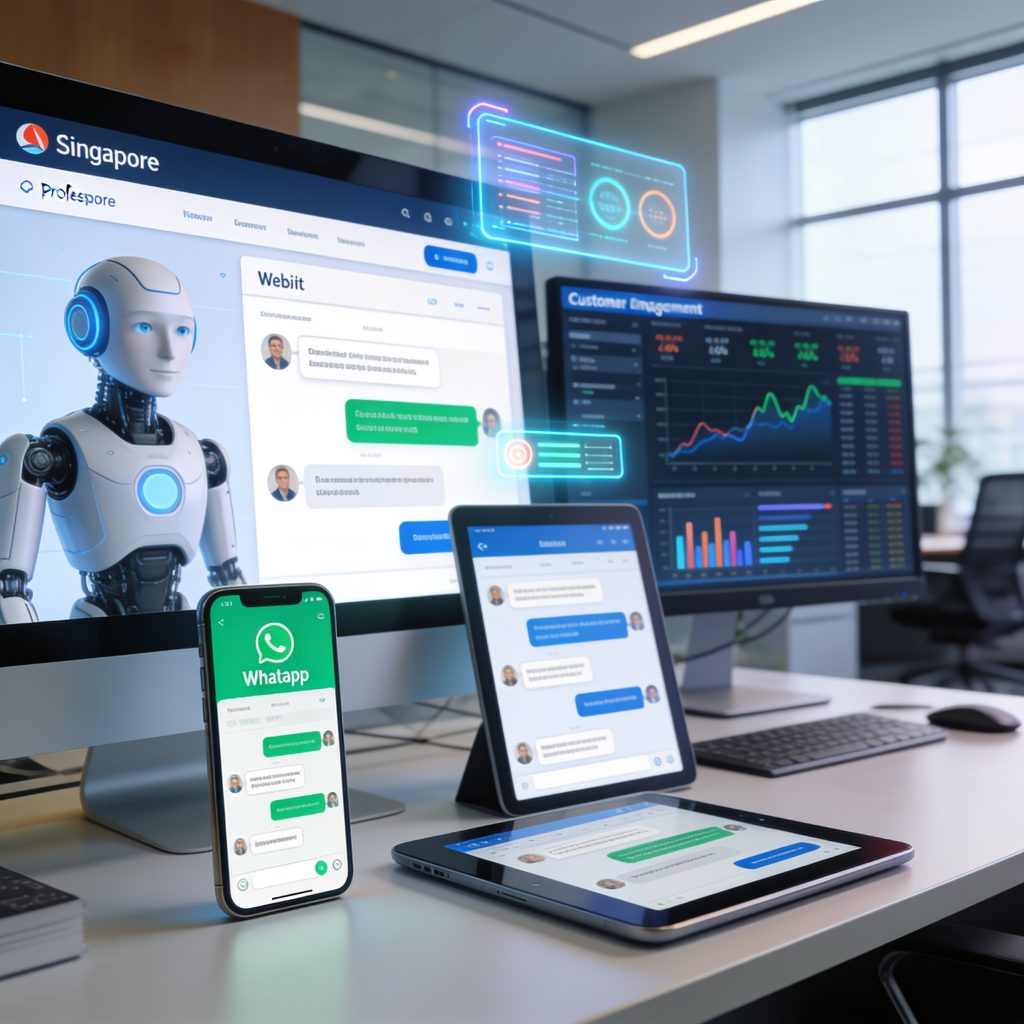
AI Chatbot and AI Customer Service: Transforming Customer Experience in Singapore
Customer expectations have changed dramatically over the past decade. Today’s customers expect instant responses, personalized interactions, and seamless support across multiple channels. Whether they are browsing a website, sending a WhatsApp message, interacting through social media, or contacting a support team, customers want accurate answers without long waiting times.
As businesses in Singapore continue their digital transformation journey, AI chatbot and AI customer service solutions have emerged as essential tools for improving customer engagement, increasing operational efficiency, and delivering exceptional customer experiences.
Modern AI-powered customer service systems are no longer limited to simple scripted responses. Advances in artificial intelligence, natural language processing (NLP), machine learning, and large language models have enabled businesses to provide human-like conversations, automate repetitive tasks, and support customers 24 hours a day.
Industry studies indicate that AI will handle a growing percentage of customer service interactions in Singapore over the next few years, helping organizations improve response speed while allowing human agents to focus on more complex customer needs.
This article explores how AI chatbots and AI customer service solutions work, their benefits, implementation strategies, industry applications, and future trends for businesses in Singapore.
What Is an AI Chatbot?
An AI chatbot is an intelligent software application designed to simulate conversations with users through text or voice interactions.
Unlike traditional rule-based chatbots that follow predefined scripts, AI chatbots can:
- Understand natural language
- Interpret customer intent
- Learn from previous interactions
- Provide contextual responses
- Support multiple languages
- Escalate complex cases to human agents
Modern AI chatbots can be deployed across:
- Corporate websites
- WhatsApp Business
- Facebook Messenger
- Instagram Messaging
- Telegram
- Mobile applications
- Customer portals
- Voice assistants
- Contact centers
The ability to operate across multiple communication channels creates a unified customer experience regardless of where customers initiate contact.
Understanding AI Customer Service
AI customer service refers to the use of artificial intelligence technologies to support, automate, and enhance customer support operations.
Rather than replacing customer service teams, AI works alongside human agents to:
- Answer frequently asked questions
- Route inquiries
- Summarize conversations
- Manage tickets
- Capture customer information
- Recommend solutions
- Analyze sentiment
- Escalate sensitive issues
Organizations are increasingly implementing AI customer service to improve customer satisfaction while reducing operational costs and response times.
Why Businesses Are Investing in AI Customer Service
1. Rising Customer Expectations
Customers expect immediate support regardless of business hours.
Traditional support teams face challenges such as:
- High inquiry volumes
- Limited staffing
- Long response times
- Multi-channel complexity
AI chatbots help address these challenges by providing instant responses around the clock.
2. Increasing Operational Efficiency
Support teams often spend significant time answering repetitive questions such as:
- Product information
- Delivery status
- Appointment scheduling
- Account updates
- Pricing inquiries
AI can automate these routine interactions, allowing staff to focus on higher-value conversations.
3. Cost Optimization
Expanding customer support traditionally requires hiring additional staff.
AI customer service systems can simultaneously manage thousands of conversations, helping businesses scale support operations without proportionally increasing headcount.
4. Improved Customer Satisfaction
Customers value:
- Faster responses
- Consistent information
- Personalized experiences
- Convenient self-service options
AI solutions help businesses deliver these experiences consistently.
Key Features of Modern AI Chatbots
Natural Language Understanding (NLU)
Modern chatbots understand customer intent rather than relying solely on keywords.
For example:
Customer:
“Can I change my delivery date?”
AI understands the request and provides relevant assistance even if the wording varies.
Multilingual Support
Singapore’s diverse population benefits greatly from multilingual AI capabilities.
Modern AI chatbots can communicate in:
- English
- Mandarin
- Malay
- Tamil
- Additional international languages
This enables businesses to serve a broader customer base effectively.
Omnichannel Communication
Customers may switch between channels during their journey.
AI customer service platforms can unify conversations across:
- Website chat
- Social media
- SMS
- Voice systems
This creates a seamless customer experience.
Human Escalation
Not every issue should be automated.
Effective AI customer service solutions include intelligent escalation rules that transfer complex, sensitive, or high-priority cases to human agents.
Knowledge Base Integration
AI chatbots can connect with:
- Product catalogs
- FAQs
- Internal documentation
- Service manuals
- Policy databases
This allows customers to receive accurate and consistent information.
Lead Generation and Qualification
AI chatbots are increasingly used for sales and marketing functions.
Capabilities include:
- Collecting contact information
- Identifying customer needs
- Qualifying leads
- Scheduling appointments
- Guiding prospects through the buying journey
These features help businesses generate opportunities even outside office hours.
Benefits of AI Chatbots for Businesses
24/7 Availability
Customers can receive support at any time without waiting for business hours.
This is particularly valuable for:
- E-commerce businesses
- International companies
- Service providers
- Healthcare organizations
- Educational institutions
Faster Response Times
AI responds within seconds, significantly reducing waiting times.
Research indicates organizations implementing AI customer service experience substantial improvements in response efficiency.
Consistent Customer Experience
Human responses may vary between agents.
AI ensures:
- Consistent messaging
- Accurate information
- Standardized workflows
- Brand-aligned communication
Increased Agent Productivity
AI can:
- Summarize conversations
- Categorize tickets
- Recommend responses
- Gather customer information
This reduces administrative workload and improves agent productivity.
Data Collection and Analytics
AI platforms provide insights into:
- Customer behavior
- Common inquiries
- Service bottlenecks
- Satisfaction trends
- Conversion rates
These analytics support informed business decisions.
AI Customer Service Use Cases
Retail and E-Commerce
AI chatbots can:
- Answer product questions
- Track orders
- Process returns
- Recommend products
- Handle delivery inquiries
Financial Services
Applications include:
- Account assistance
- Loan inquiries
- Payment support
- Appointment booking
- Customer verification
Healthcare
Healthcare organizations use AI for:
- Appointment scheduling
- Patient FAQs
- Service information
- Follow-up reminders
Education
Educational institutions leverage AI to:
- Answer admission inquiries
- Support student services
- Provide course information
- Assist prospective students
Real Estate
Real estate companies use AI chatbots to:
- Capture leads
- Schedule viewings
- Provide property information
- Qualify prospects
Hospitality
Hotels and travel businesses utilize AI for:
- Booking assistance
- Reservation management
- Guest inquiries
- Service recommendations
AI Chatbot Integration Capabilities
Modern AI platforms can integrate with existing business systems including:
- CRM systems
- ERP platforms
- Customer support software
- Payment gateways
- Booking systems
- Inventory management systems
- Marketing automation tools
Integration enables AI to become part of the business workflow rather than operating as a standalone solution.
Best Practices for Implementing AI Customer Service
Start With Common Questions
Successful implementations typically begin with:
- FAQs
- Order status inquiries
- Appointment bookings
- Basic support requests
This allows businesses to achieve quick wins.
Maintain Human Oversight
AI performs best when combined with human expertise.
Organizations should:
- Define escalation rules
- Monitor conversations
- Review AI responses
- Continuously improve workflows
Industry experts consistently emphasize the importance of human oversight in AI customer service.
Train AI With Business Knowledge
AI effectiveness depends heavily on data quality.
Businesses should provide:
- Product information
- Service documentation
- FAQs
- Support procedures
- Company policies
Measure Performance
Key performance indicators include:
- Response time
- Resolution rate
- Customer satisfaction
- Ticket deflection rate
- Lead conversion rate
- Escalation frequency
Continuous measurement drives improvement.
Common Challenges and How to Overcome Them
Customer Trust
Some customers still prefer speaking with humans.
Solutions include:
- Clear escalation paths
- Transparent communication
- Human handoff options
Accuracy and Hallucinations
AI can occasionally generate incorrect responses.
Organizations should implement:
- Knowledge-based responses
- Human review processes
- Governance controls
- Regular testing
These controls are increasingly recognized as essential for successful AI deployments.
Data Privacy and Security
Businesses must ensure:
- Secure data handling
- Compliance requirements
- Access controls
- Encryption standards
Security remains a major consideration in AI adoption.
The Future of AI Chatbots in Singapore
AI customer service is rapidly evolving from simple automation toward intelligent business assistants.
Future developments include:
Generative AI Conversations
More natural and personalized interactions.
Voice AI
Human-like voice conversations across customer service channels.
Predictive Customer Support
AI identifying issues before customers report them.
Autonomous Workflows
AI handling increasingly complex processes with minimal intervention.
Hyper-Personalization
Customer experiences tailored based on behavior, preferences, and historical interactions.
Why AI Chatbots Are Becoming Essential for Modern Businesses
Organizations that adopt AI customer service gain advantages in:
- Customer satisfaction
- Operational efficiency
- Lead generation
- Scalability
- Cost management
- Competitive differentiation
As customer expectations continue to rise, businesses that combine AI automation with human expertise will be best positioned to deliver exceptional service experiences.
The goal is not replacing human agents. The most successful organizations use AI to eliminate repetitive work, provide instant support, and empower employees to focus on complex interactions that require empathy, judgment, and relationship building.
FAQ
What is an AI chatbot?
An AI chatbot is software that uses artificial intelligence and natural language processing to understand customer questions and provide automated responses through text or voice conversations.
How does AI customer service work?
AI customer service uses machine learning and conversational AI to answer questions, route inquiries, summarize conversations, and support customer service teams with faster issue resolution.
Can AI chatbots replace customer service agents?
No. AI chatbots are most effective when working alongside human agents. They handle repetitive inquiries while humans manage complex or sensitive situations.
What channels can AI chatbots support?
Modern AI chatbots can operate on websites, WhatsApp, Facebook Messenger, Instagram, SMS, email, mobile apps, customer portals, and voice systems.
Are AI chatbots suitable for small businesses?
Yes. Small businesses can use AI chatbots to provide 24/7 support, capture leads, automate common inquiries, and improve customer engagement without significantly increasing staffing costs.
Can AI chatbots support multiple languages?
Yes. Advanced AI chatbots can support multiple languages including English, Mandarin, Malay, and many others.
How secure are AI customer service systems?
Security depends on implementation. Businesses should choose solutions with strong encryption, access controls, compliance measures, and secure data management practices.
What industries benefit most from AI customer service?
Retail, e-commerce, healthcare, finance, education, hospitality, logistics, real estate, and professional services all benefit from AI-powered customer support solutions.
How long does it take to implement an AI chatbot?
Implementation timelines vary depending on complexity, integrations, and customization requirements. Basic deployments can often be completed within days or weeks, while enterprise solutions may require longer planning and testing phases.
What should businesses look for in an AI chatbot platform?
Key considerations include multilingual support, omnichannel capabilities, CRM integration, analytics, scalability, security, human escalation features, and customization options.